The Saturday Morning Call That Cost $14,000
One Eagle Trace homeowner ran the dishwasher before leaving for a soccer tournament. The supply line fitting, original to a 2009 install, had been weeping for months behind the cabinet wall. That morning it let go entirely. Six hours later the family came home to water seeping out from under the kick plate and a buckled hardwood floor that ran fifteen feet into the living room.
When our team arrived, in most cases within 2 hours of the call, the moisture readings on the oak planks were already past 28 percent. The subfloor underneath was saturated. The cabinet bases had wicked water up about four inches, and the drywall behind the dishwasher showed the dark staining we associate with several hours of contact. This was no longer a clean water job. Sitting that long against organic materials, it had drifted toward Category 2, which we explain in detail in our category 1 vs 2 vs 3 breakdown.
The lesson buried in this story is not about the fitting. It is about the six hours. If anyone had been home, the shutoff valve under the sink would have stopped it in two minutes.
The Tuesday Night Call That Cost $400
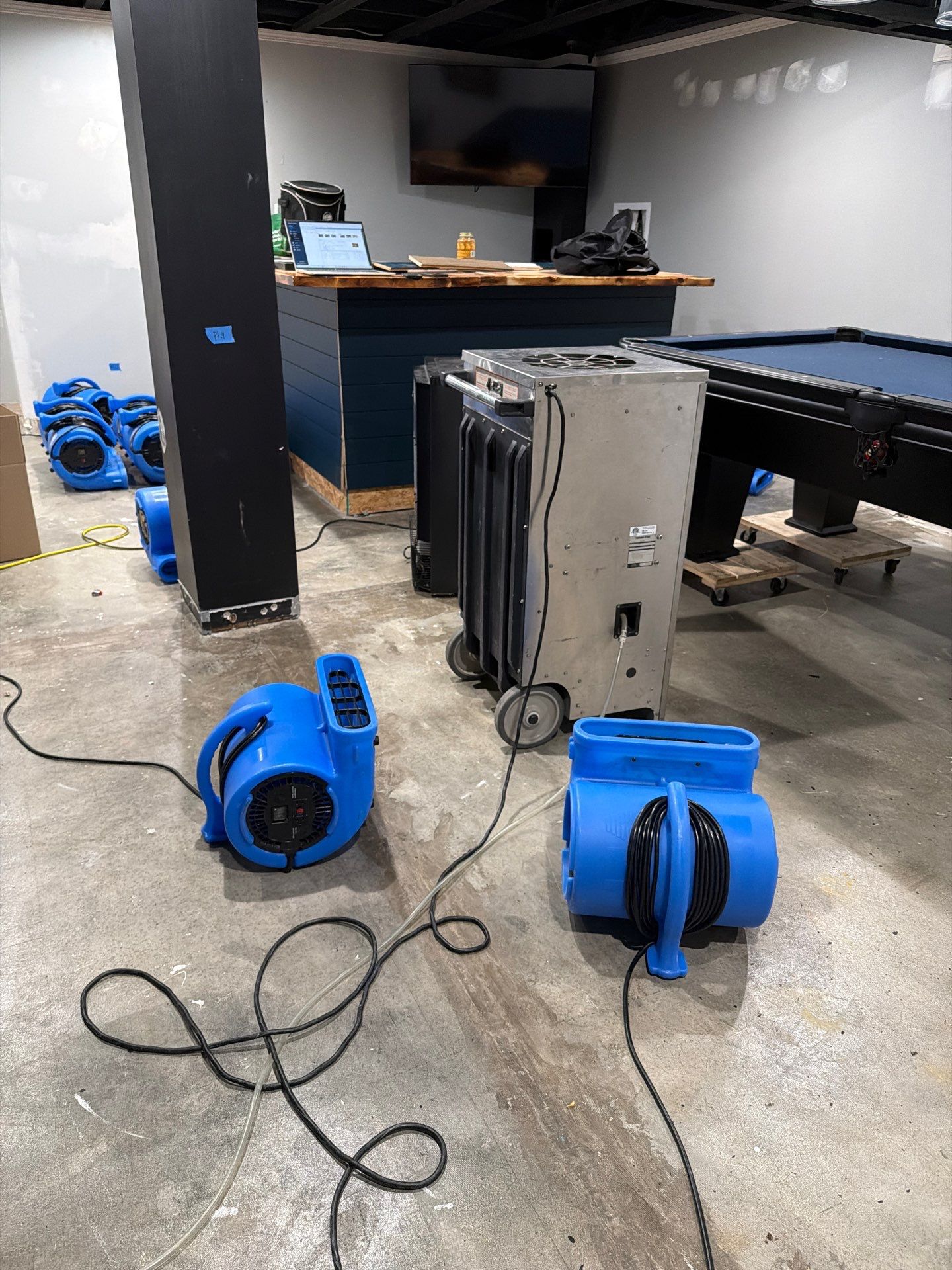
Compare that to a homeowner over near Eagle Trace (Core Subdivision) who heard an odd hissing during the rinse cycle, opened the cabinet, saw water beading on the braided line, and shut the angle stop immediately. She called us at 9:14 p.m. We were on site by 11. Total water on the floor, maybe two gallons. We pulled the dishwasher, dried the substrate under the unit with two air movers and a small dehumidifier, monitored for 48 hours, and closed the file. No demo, no claim, no drama.
The difference between $400 and $14,000 was about ninety seconds of homeowner response time. That is it.
What made her response work was not technical knowledge. She did not know what a braided supply line was before that night. She just trusted that an unusual sound from an appliance meant something, and she checked. That instinct, the willingness to walk into the kitchen instead of turning up the television, is honestly the single biggest factor we see separating cheap jobs from expensive ones.
What the Numbers Actually Look Like
After years of these jobs in Central Indiana, the cost spread is pretty consistent. Caught in under ten minutes, you are usually looking at $300 to $800, mostly drying labor and a service call. Caught within 2 hours or two, the range jumps to $1,500 to $3,500 once cabinet kick plates and a few feet of flooring come into play. Past the six hour mark, you are in $6,000 to $12,000 territory because hardwood has cupped and subfloor needs replacement. The slow hidden leak, the one running for weeks or months unseen, almost always lands between $8,000 and $18,000 once mold remediation gets folded in. Those ranges reflect typical Eagle Trace jobs including cabinet, flooring, and any required mold scope.
Prevention That Actually Holds Up
One family we worked with in Eagle Trace two years ago has not called back, and we know why. After the first claim they did four things: replaced the rubber supply line with a stainless braided one, installed a $12 leak detector puck under the dishwasher, started running the unit only when someone was home, and committed to checking the cabinet base every six months when the furnace filter gets changed.
- Replace rubber or vinyl supply lines every 5 to 7 years, sooner if discolored
- Install a battery powered leak sensor under the unit and one under the adjacent sink
- Know where the dishwasher shutoff is before you need it
- Never run the dishwasher overnight or while the house is empty
- If you smell anything musty near the kitchen cabinets, open them and look
That homeowner spent under $80 on prevention. The original claim was $7,200.
The First Hour: What That Homeowner Did Right
The Tuesday night caller followed roughly the sequence we wish everyone knew. Shut the angle stop under the sink. Kill power to the dishwasher at the breaker, never just the button on the front. Pull towels, not a mop, since wringing recontaminates. Lift area rugs and anything wooden off the floor. Take photos before touching anything else. Then call a restoration contractor, not a plumber first. The plumber fixes the leak. We dry the structure. Both are needed but in that order.
One detail people miss: do not open the dishwasher door right away if water is still inside the tub. We have had homeowners release another two or three gallons onto an already wet floor trying to investigate. Let it sit until power is off and the supply is shut, then drain it slowly with towels staged at the base.
The Hidden Leak Nobody Saw Coming
A Eagle Trace family bought a home last spring. The inspector flagged nothing in the kitchen. Eight months later they noticed the hardwood near the dishwasher feeling a little spongy underfoot. By the time we opened the cabinet, the particleboard floor of the sink base had turned to oatmeal and a colony of mold was thriving on the back wall. The dishwasher drain hose had a pinhole, slow enough that the steady drip evaporated between cycles but wet enough to keep the cavity above 80 percent humidity.
This is the kind of failure that does not announce itself. We covered the warning signs in our piece on signs of hidden water damage, and almost every one of them was present in that kitchen if anyone had known to look. The remediation ran past $9,000 because mold had crossed into S520 territory, which is a different scope of work entirely.
The detail that still bothers me about that job was the smell. The homeowner mentioned a faint sour odor in the kitchen that had been there since they moved in. They assumed it was the previous owner's cooking lingering in the cabinets. It was not. It was the wood inside the cabinet base decomposing, slowly, eight months of it. A flashlight and ten minutes would have saved them most of nine thousand dollars.
When To Call Eagle Trace Water Restoration
If you are standing in a wet kitchen reading this on your phone, stop reading and shut the angle stop. Then call us. Our crews dispatch in most cases within 2 hours across the Eagle Trace area, and the first thing we will do is take moisture readings to figure out whether you are looking at a $400 job or something larger. The earlier we get there, the smaller that number stays. We would rather show up to a two gallon spill than a buckled hardwood floor, every single time.